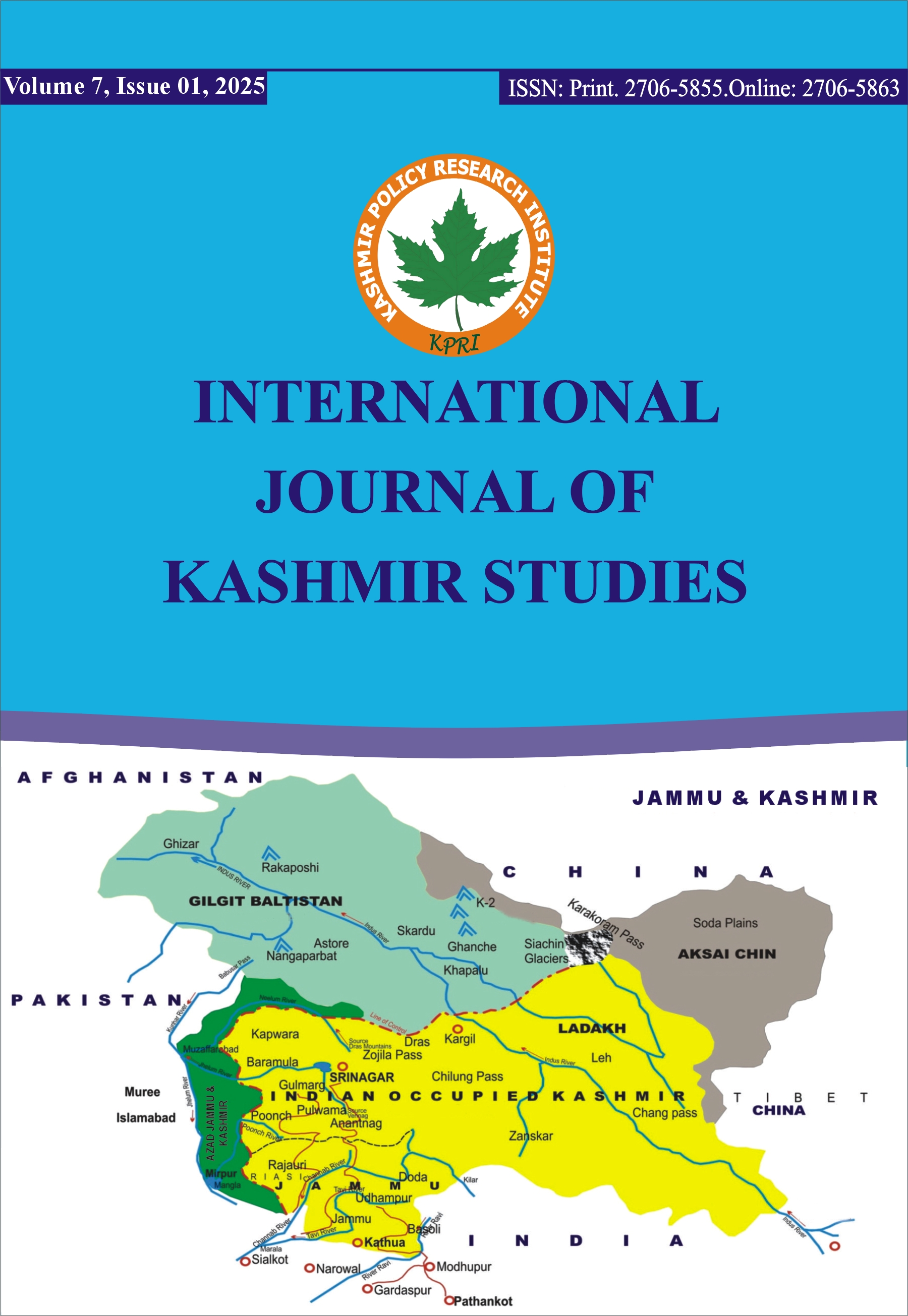
Militarization and Everyday Life in Indian-Administered Kashmir Post-1989
Abstract
This qualitative study explores the pervasive impact of militarization on everyday civilian life in Indian-administered Kashmir since the outbreak of armed insurgency in 1989. Drawing on a wide range of scholarly literature, human rights reports, ethnographic accounts, and journalistic sources, the research synthesizes how protracted conflict and the continuous presence of military forces have fundamentally restructured the region's socio-economic, political, and psychological landscape. The analysis is structured around four central themes: economic dislocation and structural violence¹; gendered experiences, particularly those of women facing displacement, trauma, and activism; youth alienation amidst educational disruption and identity struggles; and the widespread surveillance and militarization of public space. Guided by theoretical frameworks such as structural violence, biopolitics, necropolitics, and everyday resistance, the study highlights how militarization operates not only as a security strategy but as a system of governance that penetrates all aspects of daily life. Despite enduring state control and systemic violence, Kashmiri civilians continue to exhibit resilience through subtle and overt forms of resistance. The paper underscores the urgency of re-centering civilian experiences in policy discussions and calls for a reimagining of peace that prioritizes demilitarization, justice, and dignity for the people of Kashmir.
Downloads